
How to Map Local Search Intent When Customers Search in Full Sentences
A homeowner whose basement is taking on water doesn’t think in keywords. They think: the sump pump stopped working, more rain is forecast for tomorrow, and I need someone who can come out this weekend without trying to sell me a whole new drainage system. If that person types “sump pump repair near me,” your keyword tool records four words. If they ask Google’s AI Mode or Ask Maps the full question, the search carries everything else as well.
That gap is what a local search intent map is meant to close. It sits next to your keyword research and records the situations, deal-breakers and deciding factors behind each service you offer, so your website and Google Business Profile can show, with real evidence, that you are a good fit for them.
This guide builds on a recent Search Engine Land article by Rich Sanger, 6 steps to map local search intent beyond keyword data. It adds a worked example, a “proof gap” check and a simple template you can use yourself.
Why a keyword list no longer tells the whole story
Keyword research still shows which services people look for, how they phrase them and roughly how much demand each one has. That hasn’t stopped being useful.
What has changed is how much a single search can say. When Google introduced AI Mode in March 2025, it explained that the feature uses a “query fan-out” technique: it runs several related searches across subtopics and data sources at the same time, then combines what it finds into one answer. At Google I/O two months later, the company said people were coming to Search with longer and more complex questions. And in March 2026, Google Maps added Ask Maps, a Gemini-powered way to ask Maps real-world questions in plain language, starting in the US and India.
Google hasn’t published how these systems choose which local businesses to mention, so it’s worth being careful here. Still, if a detailed question is broken into smaller ones (“who repairs sump pumps nearby,” “who offers weekend appointments,” “who tends to fix rather than replace”), it seems sensible to make sure your own website and profile answer those smaller questions clearly. At worst, the customer reading your page gets better information.
It’s also worth knowing that Google’s own documentation says there are no additional requirements or special optimizations needed to appear in AI Overviews or AI Mode. The same SEO fundamentals apply, including keeping your Business Profile information up to date. So intent mapping isn’t a trick for AI search. It’s a way of applying those fundamentals to the specific people you serve.
What a local intent map records
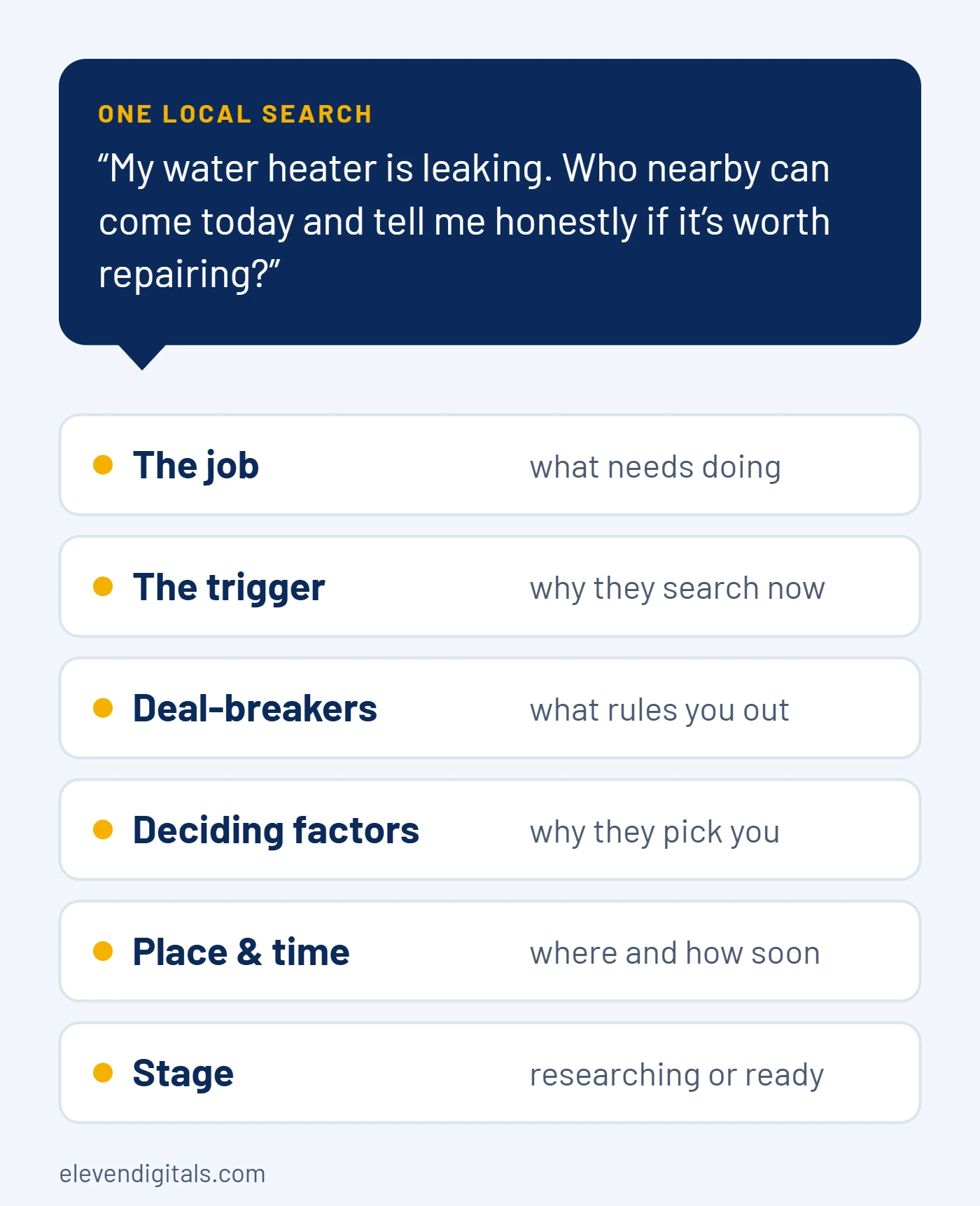
Sanger’s framework looks at each important service from a few angles. In plain terms, we’d describe them like this:
- The job: what the customer needs done.
- The trigger: what happened that made them search today.
- Deal-breakers: anything that rules a business out straight away.
- Deciding factors: what tips the choice between businesses that can all do the work.
- Place and time: where the work happens and how soon it is needed.
- Stage: whether the person is researching, comparing options or ready to book.
To show the format, here’s a made-up example for a residential plumber. It isn’t data from a real business.
Water heater: ready to book
- Trigger: 12-year-old tank leaking at the base
- Deal-breaker: No same-day visit
- Deciding factor: Honest repair-or-replace advice
- Place and time: Within the service area, today
- Stage: Ready to book
Water heater: comparing
- Trigger: Considering a switch to tankless
- Deal-breaker: Not licensed for gas line work
- Deciding factor: Clear written quote, financing options
- Place and time: Service area, next few weeks
- Stage: Comparing
Drain cleaning: diagnosing
- Trigger: Same kitchen clog keeps coming back in an older home
- Deal-breaker: No camera inspection
- Deciding factor: Explains the cause, not just a quick fix
- Place and time: Service area, evenings preferred
- Stage: Diagnosing
A hypothetical intent map for a residential plumber. Keyword research shows the demand; the map shows what each customer is trying to solve.
Two of those examples sit under the same keyword (“water heater”), yet they describe very different customers. A keyword list would lump them together. The map keeps them apart, because each one needs different page content, profile details and proof before they’d feel confident calling.
How to build a local intent map in six steps
Step 1: Start with the keyword research you already have
List your services, the terms customers use for them, location modifiers and the questions that come up repeatedly. Use search volume to decide which services deserve attention first. Pay attention to wording differences, too: customers often describe a service differently from how the business names it internally. If you need a starting point, our local SEO checklist covers the basics, and our local keyword research service explains how we group searches by service, area and intent.
Step 2: Write down what triggers each search and what rules a business out
For each priority service, answer three questions. What usually happens just before someone needs this? What would make them reject a business immediately? And which capabilities do people ask about before they agree to anything? For a roofer, a trigger might be storm damage and a deal-breaker might be not handling insurance claims. Only record patterns that come up with several customers. One unusual request does not belong on the map.
Step 3: Find out how people choose between capable businesses
When several businesses can clearly do the job, something else decides who gets the call. “Best plumber” sounds like one intent, but “best” might mean fastest to arrive, clearest on price or least likely to upsell. In his own Ask Maps tests, Sanger saw that as questions became more situational, the answers tended to describe businesses by qualities like honesty, responsiveness and specialization. That’s one practitioner’s observation, not something Google has documented, and results like these can change. The underlying point holds either way: people choose on these qualities, so write them down for each service.
Step 4: Collect customer language from places keyword tools can’t see
Often the best intent research is simply customers describing their problem in their own words. Most businesses already have access to these sources, and they cost little or nothing:
| Source | What it reveals | A simple way to use it |
|---|---|---|
| Phone calls and enquiry forms | Worries and questions right before booking | For four weeks, note the first question each caller asks, then tally the results |
| Your own Google reviews | What customers valued after the job | Once a quarter, list the phrases that repeat across reviews |
| Competitors’ reviews | Frustrations and unmet expectations | Read the 1 to 3 star reviews of businesses in your local pack |
| Google Search Console | Longer real queries already reaching your site | Filter the Performance report for queries of six words or more |
| People Also Ask and autocomplete | Common follow-up questions | Search your main services and record the questions that appear |
| Reddit, forums and local community groups | Unfiltered language about bad experiences | Search “[service] + [your city]” and note recurring complaints |
Across all of these, repetition is the signal. A concern that appears in calls, reviews and forum threads deserves a place on the map. A one-off comment does not.
Step 5: Group findings by service, and stop chasing exact phrasings
Organize what you found under each service rather than leaving it as a long list of notes. Some factors will repeat across services, which is useful to know: fast response, for example, might matter for both emergency repairs and maintenance contracts.
This is also where zero-volume searches start to make sense. A question like “emergency vet open late that is good with nervous cats” may show no measurable volume as a phrase. But “emergency vet,” “24 hour vet” and “cat anxiety at the vet” each have demand of their own, and your call notes or reviews may show how often those needs appear together. The target is the recurring need underneath, not the exact sentence. Conversational search multiplies the ways people can combine their needs, so trying to match every phrasing is a losing game.
Step 6: Test the map in conversational search, carefully
Once the map is based on real customer evidence, you can test it in AI Mode, Ask Maps (where available), Gemini or ChatGPT. Start with a basic request, then add one detail at a time:
- “Plumber near me for a leaking water heater.”
- “Plumber near me who can come today for a leaking water heater.”
- “My water heater is about 12 years old and leaking at the base. I need a plumber who can come today and will tell me honestly whether it is worth repairing.”
Note which businesses appear, how they are described and what seems to support that description. Treat this as observation, not measurement: results vary by location, device and personalization. And don’t ask an AI tool to invent a hundred “customer prompts” and call it demand. Generated prompts show what a model can imagine, not what your customers actually ask.
Turn the map into changes customers can see
An intent map only earns its keep if it changes what you publish and how your profile reads. The most useful place to start is checking whether you can actually back up the things customers care about.
Run a proof gap check
For every deciding factor and deal-breaker on your map, ask two questions: do we say this anywhere, and can a customer find evidence that it’s true? Plenty of good businesses deliver exactly what customers want and leave no trace of it online. For the made-up plumber, the check might look like this:
| What customers care about | Where the business says it | Evidence a customer can find | Next step |
|---|---|---|---|
| Honest repair-or-replace advice | Homepage line: “We repair first” | No reviews mention it yet | Ask recent repair customers for an honest review, without scripting what they say |
| Same-day visits | Business Profile description | Service page lists the daily cut-off time and hours | Covered; keep hours accurate |
| Tankless installation | Listed as a Business Profile service | No project photos and no dedicated page | Add a service page and photos of real installs |
To decide what to fix first, weigh three things together: how often the need comes up, how valuable that type of job is, and how big the proof gap is. A common, valuable need with no supporting evidence is usually the best place to start.
Update your website
- Give each core service page a section that speaks to its common triggers (“If your water heater is leaking at the base…”).
- Answer the usual deal-breaker questions directly: response times, licensing, service area, pricing approach and financing, if you offer it.
- Add FAQs drawn from real calls rather than invented ones.
- Use case studies and project photos only when they are real. A genuine example of a job carries far more weight than a broad claim.
Update your Google Business Profile
Google’s Business Profile help center says local results are based mainly on relevance, distance and prominence, and that complete, detailed business information helps Google match a profile to relevant searches. Your intent map tells you which details matter most:
- Check that your primary and secondary categories reflect the services on your map.
- Add services with short descriptions that mention the situations you handle.
- Fill in relevant attributes and keep hours, including special hours, accurate.
- Upload photos of real work that shows the capabilities customers ask about.
- Reply to reviews in a way that confirms specifics, without stuffing keywords.
Stay inside the guidelines while you do this. Don’t add keywords to your business name, and never buy, gate or incentivize reviews. Our guides on how to optimize a Google Business Profile and common Business Profile mistakes go into more detail.
Don’t create a page for every prompt
Resist building a new page for every long question you find. Thin, near-identical pages make a site harder to use. Let one strong service page answer many variations of the same need.
Where AEO and GEO fit
AEO (answer engine optimization) and GEO (generative engine optimization) are industry terms for showing up in AI-generated answers. For local businesses, the overlap with intent mapping is fairly simple: clear, specific information you can back up gives both people and AI systems more to go on. Nobody can guarantee a mention in AI answers, though, and we’d be wary of anyone who does. The work worth doing is the same work that helps customers decide.
A simple template to start with
You don’t need special software. A spreadsheet with these columns is enough:
- Service
- Main keywords and rough demand
- Common triggers
- Deal-breakers
- Deciding factors
- Place and time
- Stage
- Where you say it (website page, profile field)
- Evidence customers can find (reviews, photos, case studies)
- Next action and priority
Start with your three most valuable services and around a month of call notes. Revisit the map every quarter, or whenever you add a service or area. Small and accurate beats large and guessed.
Frequently asked questions
Is search volume still useful for local SEO?
Yes. Volume shows where demand is and helps you decide which services to focus on first. An intent map adds context to that data; it doesn’t replace it.
Do I need special schema or an AI text file to appear in AI search?
For Google’s AI Overviews and AI Mode, Google says no. A page needs to be indexed and eligible to show with a snippet, and normal SEO best practices apply. Structured data should still match what is visible on the page.
Final thoughts
Customers have always had detailed reasons for choosing one local business over another. Conversational search just lets them say those reasons out loud. A local intent map helps you hear them and back up your answers with real evidence instead of more keywords.
If you’d like help working out which local searches matter for your services, and what your pages and profile should say about them, have a look at our local keyword research and Business Profile optimization services. Or book a free strategy call: we’ll review how your business currently shows up on Google and tell you what we’d work on first, with no obligation.
Credit: the intent-mapping framework discussed here comes from “6 steps to map local search intent beyond keyword data” by Rich Sanger, published in Search Engine Land on October 26, 2026. The worked examples, proof gap check and template are our own additions. All examples are hypothetical, not client results.